 |
Code Examples
A repository of 155 code examples for BeepBeep
|
|
Code Examples
A repository of 155 code examples for BeepBeep
|
Evaluate an event stream based on a distance to a reference trend. More...
Classes | |
| class | AverageValueAbsolute |
| Trend distance based on the average of values in a stream. More... | |
| class | AverageValueRelative |
| Trend distance based on the average of values in a stream. More... | |
| class | MaxSymbols |
| Trend distance based on the maximum number of distinct symbols in a stream. More... | |
| class | SymbolDistribution |
| Trend distance based on the statistical distribution of symbols in a stream. More... | |
| class | SymbolDistributionClusters |
| Trend distance based on the statistical distribution of symbols in a stream. More... | |
Evaluate an event stream based on a distance to a reference trend.
The examples in this section make use of the TrendDistance pattern, illustrated as follows.
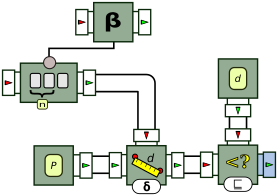
This pattern can be interpreted as follows:
Window processor to keep a suffix of width n P) is given to a distance function (δ) along with the trend computed over the window. ⊑), which checks if that distance is "smaller" than some given distance threshold (d) It is possible, however, to encapsulate this process into a GroupProcessor, which becomes a generic pattern whose actual computation is based on six parameters: n, β, P, δ, ⊑, and d.
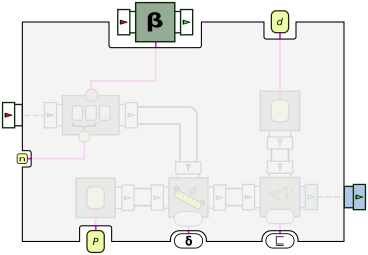
Depending on how these six parameters are instantiated, the TrendDistance processor computes different things. The examples in this section show different ways of using the TrendDistance pattern.
 1.8.13